Monk fruit extract has gained global recognition as a natural zero-calorie sweetener, prized for its intense sweetness and health benefits. As a leading fruit and vegetable extract manufacturer, understanding the meticulous production process is essential to delivering high-quality products. This article outlines the comprehensive manufacturing workflow, from raw material selection to final packaging, ensuring purity and potency in every batch.
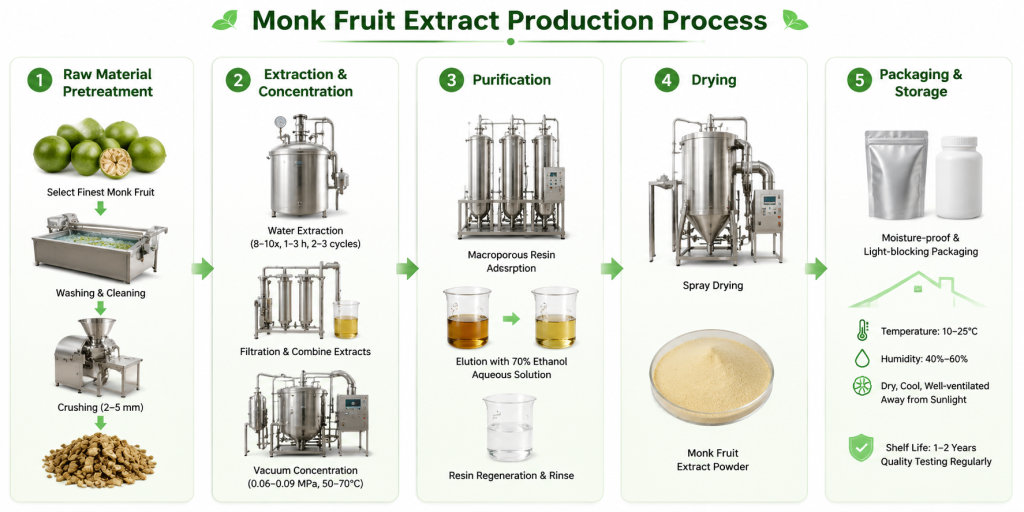
1. Raw Material Pretreatment: Selecting the Finest Monk Fruit
The journey begins with careful selection of fresh monk fruit. Optimal maturity is critical—fruits with insufficient maturity contain lower active compounds, while overripe fruits risk degradation of key components like mogrosides. Visual inspection and tactile evaluation help identify ideal specimens, supplemented by laboratory testing when necessary.
Once selected, the fruits undergo thorough cleaning. They pass through spraying equipment with flowing water for 1-2 minutes to remove surface dirt and dust, followed by soaking in clean water for 5-10 minutes to soften stubborn impurities. Finally, a crusher breaks the fruit into uniform particles of 2-5 millimeters, significantly enhancing subsequent extraction efficiency .
2. Extraction and Concentration: Releasing Active Compounds
The crushed monk fruit is transferred to extraction tanks where water is added at 8-10 times the weight of the raw material. The mixture is heated to boiling and maintained at a gentle simmer for 1-3 hours. Generally, 2-3 extraction cycles are performed, with filtration after each cycle and combining the filtrates.
Key parameters significantly influence extraction results:
- Time: Insufficient time leaves active compounds unextracted; excessive time may degrade heat-sensitive components
- Temperature: Overheating accelerates solvent evaporation and risks destroying beneficial compounds
- Solvent ratio: The 8-10x ratio optimizes yield without wasting resources
For alcohol-based extraction, monk fruit is combined with 6-8 times its weight of ethanol in a reflux extraction apparatus for 2-4 hours. This method continuously recycles solvent, improving efficiency.
The extract then undergoes vacuum concentration at 0.06-0.09 MPa and 50-70°C to remove most solvent, achieving a concentration ratio of 5-10 times—meaning the concentrated liquid volume is reduced to 1/5 to 1/10 of the original.
3. Purification: Isolating High-Purity Mogrosides
Macroporous resin adsorption chromatography is employed based on the properties of active ingredients like mogrosides. These resins exhibit excellent adsorption capacity for monk fruit sweeteners. The concentrated solution passes through the adsorption column at a controlled flow rate, capturing active compounds on the resin matrix.
Elution with 70% ethanol aqueous solution collects the purified active fraction. After completion, the resin is regenerated using ethanol-sodium hydroxide solution, then rinsed with deionized water to neutral pH, ready for the next production cycle .
4. Drying: Creating the Final Powder
The purified solution undergoes spray drying—a critical step transforming liquid into stable powder. The solution is atomized through a spray dryer’s atomizer into fine droplets of 10-100 micrometers in diameter. These droplets contact hot air (inlet temperature 150-200°C, outlet 70-90°C), rapidly evaporating moisture to produce dry monk fruit extract powder. This method preserves heat-sensitive compounds while achieving excellent flowability and solubility .
5. Packaging and Storage: Preserving Quality
Quality preservation continues with proper packaging using moisture-proof, light-blocking materials such as aluminum foil bags or plastic bottles. Storage conditions require:
- Temperature: 10-25°C
- Relative humidity: 40%-60%
- Environment: Dry, cool, well-ventilated, away from direct sunlight
Under optimal conditions, monk fruit extract typically maintains a shelf life of 1-2 years. Regular quality testing monitors appearance, color, odor, moisture content, and active ingredient levels to ensure consistent product quality.